
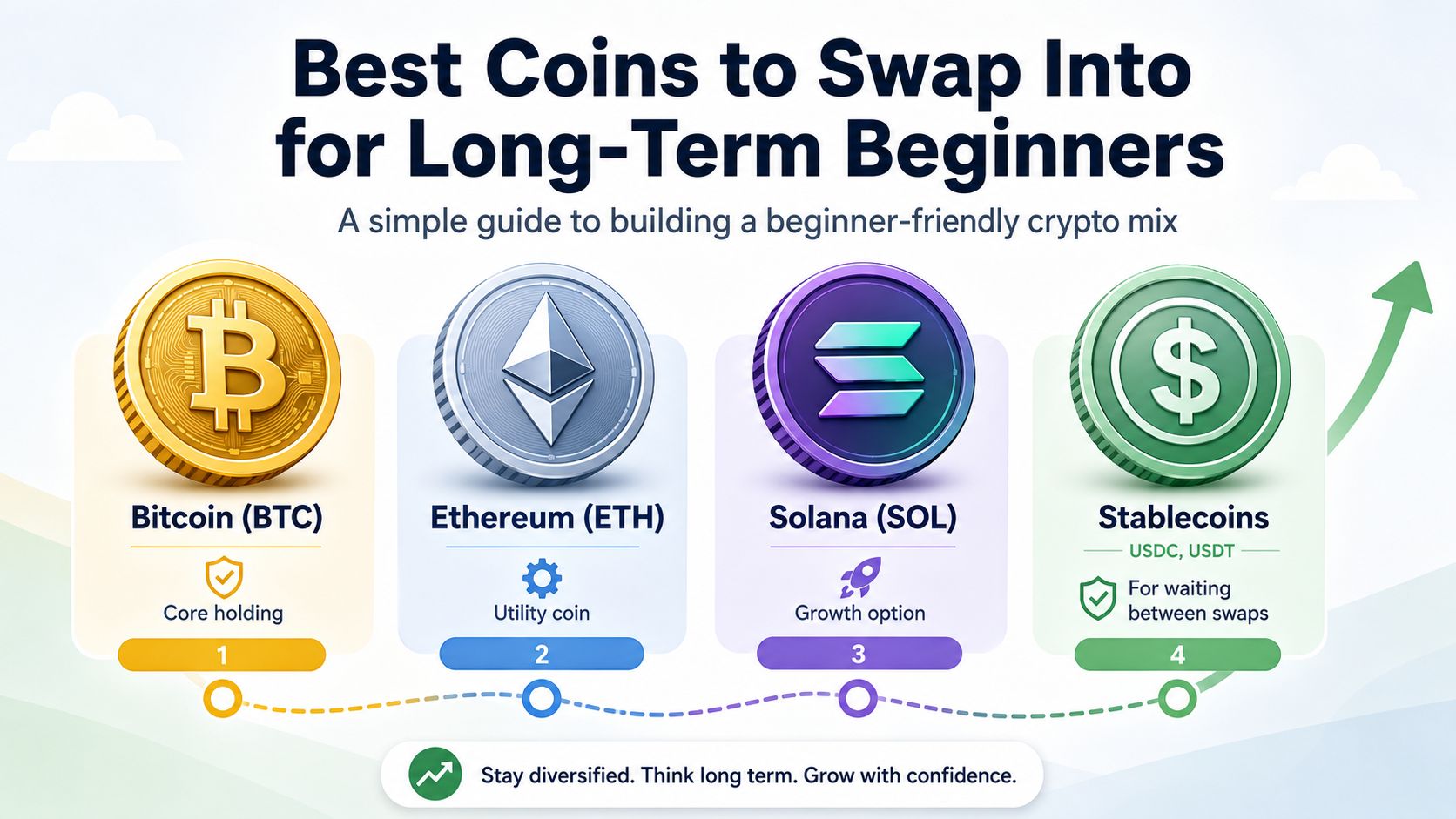
The best coins for long-term beginners are Bitcoin, Ethereum, a smaller amount of Solana, and stablecoins for waiting between swaps. As a crypto enthusiast, I would rather see a beginner own a few strong coins with clear roles than chase dozens of random tokens with weak explanations.
The crypto market has thousands of coins, and that creates confusion for new users. CoinGecko tracks more than 17,000 cryptocurrencies, while the full crypto market sits around $2.29 trillion. That number sounds huge, although most beginner attention should still go to the biggest and most liquid assets first.
My simple view is this: Bitcoin gives the portfolio a strong base, Ethereum gives exposure to blockchain apps, Solana adds a smaller growth angle, and stablecoins help beginners wait without rushing into a bad swap.
What Beginners Should Swap Into First
Beginners should swap into large, liquid, easy-to-understand coins first. I would start with Bitcoin and Ethereum before looking at smaller coins because they have the clearest use cases, the largest markets, and the longest track records among crypto assets.
Bitcoin alone represents around 56% of the global crypto market by dominance. That means more than half of the crypto market value is tied to one asset. For beginners, that matters because larger coins usually have deeper liquidity, wider exchange support, and more public information.
Ethereum adds another major layer because it powers smart contracts, DeFi, NFTs, tokens, and many blockchain apps. Together, Bitcoin and Ethereum give beginners exposure to the two biggest ideas in crypto: digital money and programmable blockchain use.
Solana can come later as a smaller position. It has strong activity and fast transactions, yet it carries more risk than Bitcoin and Ethereum. Stablecoins sit on the side as a waiting tool when the market feels overheated or when a beginner wants to pause before the next swap.
Bitcoin: Best Core Coin for Long-Term Beginners
Bitcoin is the best core coin for most long-term beginners because its purpose is simple: scarce digital money. Bitcoin has a fixed supply cap of 21 million coins, and that scarcity gives beginners a clear reason to understand the asset.
I like Bitcoin as the first crypto holding because the story does not require deep technical knowledge. There will only ever be 21 million BTC, and about 20 million BTC are already in circulation. That makes Bitcoin very different from coins that can change supply rules, launch new token models, or depend heavily on one app ecosystem.
Bitcoin also has the largest market value in crypto. Recent market data puts Bitcoin around $1.28 trillion in market cap, which gives it a much larger base than any other coin. For a beginner, that does not remove risk, although it does make Bitcoin the most established starting point.
My opinion is simple: if a beginner cannot explain why they own Bitcoin, they probably should not rush into smaller coins yet. Bitcoin teaches the most important crypto lesson first, which is long-term patience during volatility.
Ethereum: Best Utility Coin for Long-Term Beginners
Ethereum is the best utility coin for long-term beginners because it powers the largest smart contract ecosystem. If Bitcoin is mainly digital money, Ethereum is the network where many crypto applications are built.
Ethereum is currently the second-largest crypto asset by market cap, with a market value around $210 billion. That size matters because developers, wallets, exchanges, DeFi platforms, NFT tools, and layer 2 networks all connect back to Ethereum in some way.
Ethereum also changed its network through The Merge in 2022. After the move to proof-of-stake, Ethereum.org says the network reduced energy use by about 99.95%. For beginners, the key point is not the technical detail. The useful point is that Ethereum has already completed a major upgrade while staying one of the most important networks in crypto.
I would hold Ethereum as the second major long-term coin after Bitcoin. It gives beginners exposure to blockchain activity beyond simple holding. When people use DeFi, trade tokens, mint NFTs, or interact with many blockchain apps, Ethereum often sits close to the center of that world.
Solana: Best Smaller Growth Coin for Beginners
Solana is the best smaller growth coin for beginners who already understand Bitcoin and Ethereum. I would treat Solana as a growth position because it is fast, active, and cheaper to use, while still carrying more risk than the two largest coins.
Solana’s appeal comes from speed and low fees. Solana Explorer recently showed live transaction activity above 3,000 transactions per second, and Solana’s fee documentation lists a base fee of 5,000 lamports per signature, which equals 0.000005 SOL. That low-fee design helps explain why many users like Solana for trading, apps, NFTs, payments, and consumer crypto experiments.
Solana’s market cap is much smaller than Bitcoin and Ethereum, sitting around $41 billion and ranking near the top 10 on CoinGecko. That smaller size creates more room for growth during strong market periods, although it also creates more downside risk when the market turns weak.
My personal approach would be careful. Solana can be useful in a beginner portfolio, yet I would not make it the largest holding. A small Solana position gives exposure to a high-activity blockchain without turning the whole portfolio into a high-risk bet.
Stablecoins: Best Place to Wait Between Swaps
Stablecoins are best for waiting between swaps, not for long-term growth. I use stablecoins mentally as dry powder because they help a beginner stay patient when prices move too fast.
The stablecoin market is large. DeFiLlama shows stablecoins around $315 billion in total market cap. USDT is the biggest stablecoin at roughly $186 billion, and USDC is also large at roughly $75 billion. Those numbers show that stablecoins are a major part of crypto trading and liquidity.
For beginners, stablecoins are useful in three common moments. First, they help you wait before buying. Second, they help you take profit without immediately leaving crypto rails. Third, they make swaps easier because many coins trade against dollar-like stablecoin pairs.
Still, stablecoins have their own risks. They depend on issuers, reserves, regulation, and market trust. I would use them for waiting and planning, not as the main long-term investment.
Simple Coin Comparison Table
The best beginner portfolio has clear roles for each coin. I would not judge every coin by the same standard because Bitcoin, Ethereum, Solana, and stablecoins solve different problems.
| Coin | Beginner role | Data that supports the role | Main risk |
|---|---|---|---|
| Bitcoin BTC | Core long-term holding | Around $1.28 trillion market cap, around 56% crypto market dominance, fixed 21 million supply cap | Sharp price drops can still happen |
| Ethereum ETH | Main utility holding | Around $210 billion market cap, second-largest crypto asset, powers smart contracts and apps | More complex than Bitcoin |
| Solana SOL | Smaller growth position | Around $41 billion market cap, live TPS often in the thousands, very low base transaction fee | Higher volatility and stronger network competition |
| Stablecoins USDC and USDT | Waiting between swaps | Around $315 billion total stablecoin market cap, USDT and USDC dominate the category | Peg, issuer, reserve, and regulatory risk |
This table keeps the beginner decision simple. Bitcoin is the base. Ethereum is the utility layer. Solana is the growth option. Stablecoins are the waiting area.
Beginner Swap Rules
Beginners should swap with a plan before they look at prices. My view is that a simple rule set protects new users from the most common mistakes: chasing pumps, overbuying small coins, and reacting emotionally to red candles.
- Start with Bitcoin before smaller coins because it has the clearest long-term role and the largest market share.
- Add Ethereum for utility because it connects beginners to smart contracts, apps, DeFi, NFTs, and layer 2 networks.
- Keep Solana smaller than Bitcoin and Ethereum because the upside may be higher, while the risk is also higher.
- Use stablecoins when waiting because they help avoid rushed swaps during emotional markets.
- Swap in smaller amounts over time because one large trade can feel stressful when prices move quickly.
- Avoid coins that require hype to make sense because long-term beginners need clear use cases.
- Track every swap because records help with taxes, learning, and honest performance review.
- Protect the wallet first because a strong coin choice cannot fix poor security.
Crypto can reward patience, although it also punishes careless behavior fast. FINRA warns that crypto assets are risky and often extremely volatile, with the possibility of dramatic and unpredictable price swings. That warning matches what I have seen in the market for years.
For a true beginner, my final answer stays simple: build around Bitcoin and Ethereum, add Solana only as a smaller growth coin, and keep stablecoins ready for calm decision-making. That mix gives a new user a clean structure without making crypto harder than it needs to be.